Building a business takes incredible grit, and finding a path to scale that hard work is super rewarding. If you have poured years of energy into a service company, a food spot, a retail shop, or a home-care agency, franchising offers a way to expand without facing the exhaustion of opening every single new branch yourself.
Instead of carrying the entire financial and mental burden on your own shoulders, you partner with motivated people who invest in your vision.
Table of contents:
- Is Your Business Franchisable?
- A proven, profitable model
- Scalability and teachability
- Brand credibility
- Capacity and financial readiness
- Advantages and Disadvantages of Franchising
- The Step-by-Step Process of Franchising Your Business
- Step 1: Test your model and study the market
- Step 2: Set your fees and protect your intellectual property
- Step 3: Legally restructure and write the manuals
- Step 4: Build your support team and start recruiting
- How to Run a Franchise Business Successfully
- Your Master Checklist
- Final Thoughts
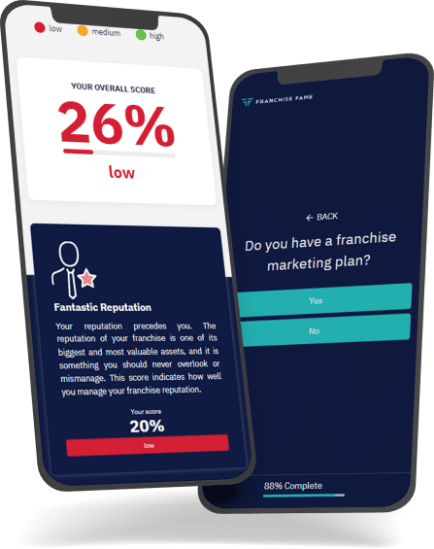
Is your franchise marketing actually driving growth?
Take our quick assessment to uncover gaps in your franchise development strategy, benchmark against industry leaders, and get a tailored action plan.
Take the Free AssessmentThis model is broadly about sharing a proven blueprint. You license your name, everyday operational systems, and hard-earned industry wisdom to independent business owners.
These partners pay an upfront fee and ongoing royalties to use your framework. In return, they get to run a business with your established business identity that consumers already recognize. Every major brand began with a single location before a collaborative network transformed it into a household name.
From working with franchises over the years, I know that moving from a single operation to a broader network requires a careful shift in strategy.
In this guide, I break down how to check your operational readiness, establish a secure legal foundation, find the right partners, and support a growing business community over the long haul. Let’s begin.
Part 1: Is Your Business Franchisable?
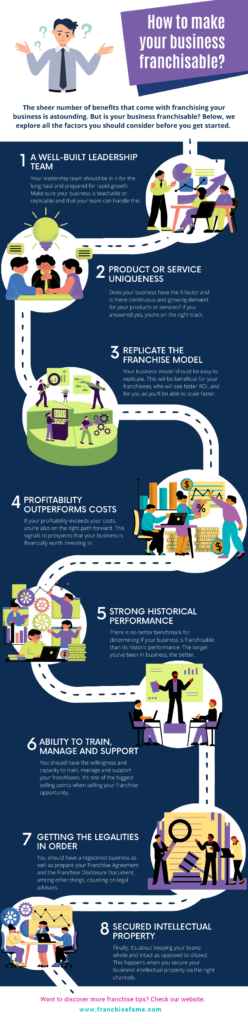
Before committing resources to expansion, you need a clear-eyed look at your operations. A concept that works beautifully under your direct supervision might face unexpected hurdles when handed over to someone else.

A proven, profitable model
Your business needs a consistent track record of solid financial performance. Prospective partners often invest their personal savings into your concept, and they need a system that offers a reliable path to a return. This means your daily tasks must rely on clear, repeatable processes rather than your personal instincts.
Healthy profit margins are essential. Industry professionals generally look for margins around 20% because this leaves enough breathing room for the operator to make a comfortable living after paying their corporate fees. You also need to show steady, predictable demand that can easily translate to another town or city.
Read also: What does a successful franchise model look like
Scalability and teachability
Scalability means your business can take root in new neighborhoods and achieve the same high standard of success. Cleaning services, fitness concepts, beauty salons, and pet care centers often have an easier time of it when transferring to new locations. Conversely, businesses tied to specific geographic traits, highly specialized machinery, or your own personal reputation can face steep hurdles.
The entire model hinges on how easily you can teach your daily methods to an outsider. If onboarding an independent operator takes longer than three months of intensive instruction, the underlying system might be too complicated to scale efficiently.
Brand credibility
The value of a network relies heavily on the reputation of its name. When people buy into your system, they are buying your local standing just as much as your training handbooks. Your brand needs a distinct identity that cuts through local competition and connects with consumers.
And you must feel confident that your standards will not slip when you are no longer watching over daily execution.
Capacity and financial readiness
Your current leadership team must have the mental bandwidth to train new owners while managing rapid corporate growth. Many founders find they need to hire a dedicated support manager before officially launching the expansion program.
This transition is a serious financial commitment. Before you see your first licensing revenue, you will face high upfront costs. You need capital for trademark filings, disclosure documents, custom legal contracts, and detailed training modules. Depending on your industry, these structural expenses can quickly add up to tens of thousands of pounds or dollars.
Part 2: Advantages and Disadvantages of Franchising
Expanding through a network comes with significant structural benefits, but it also introduces unique operational challenges.
The advantages
This model lets you grow rapidly without needing millions in corporate bank loans, as independent partners fund their own setups. This removes the main financial barrier to reaching new territories. It also builds reliable revenue streams for your main office through upfront fees and ongoing royalty payments based on gross sales.

Your hiring pressures decrease substantially because local owners recruit, pay, and manage their own teams. Furthermore, property leases and commercial loans stay with the independent operator, which protects your main business from direct financial liability. By pooling small marketing contributions into a central fund, the entire network can launch broad advertising campaigns that a single location could never afford.
Uncover what’s holding back your franchise growth
Our quick ScoreApp assessment benchmarks your franchise marketing against industry best practices and delivers personalised recommendations.
- Identify gaps in your lead generation strategy
- Benchmark against top-performing franchise brands
- Get a tailored action plan for franchise development
- Completely free — no sales call required
The disadvantages
But you must also prepare for a long delay between your initial expenses and your actual profits. This path requires a deep, decade-long commitment to relationship management and conflict resolution. You will also experience a distinct loss of daily control.
You can write the rules, but the local operators execute them, and their mistakes can hurt your regional reputation. Bad partner selection can cause long-term brand damage that is incredibly difficult to fix. Lastly, you are contractually obligated to provide continuous training and field support, which demands ongoing time and energy.
Read also: Improving the Franchisor-Franchisee Relationship – the Steps Revealed
Part 3: The Step-by-Step Process of Franchising Your Business
Once you are certain your model can scale, you can begin the practical work of building out the infrastructure.
Step 1: Test your model and study the market

Before selling your system to outsiders, prove it works across multiple locations by opening two or three corporate branches yourself. This pilot phase demonstrates that your success is not a fluke tied to your original location. It gives you a safe space to iron out operational wrinkles and provides the real-world financial data that serious buyers will ask to see.
Expanding means entering unfamiliar territory, so research your target areas thoroughly. Look closely at local demographics, regional spending habits, existing competition, and local zoning laws. What works perfectly in a bustling city might struggle in a quiet suburban town if consumer habits do not match.
Step 2: Set your fees and protect your intellectual property
The financial structure must offer a fair deal for both sides. You need a reasonable upfront fee to cover your initial training costs, alongside a sustainable monthly royalty, typically between 5% and 12% of gross sales. You also need to outline marketing fees, territory boundaries, and equipment standards.
Your brand assets, logos, and custom workflows are the crown jewels of your company. Secure trademark registration across all your target regions before talking to prospects. Use non-disclosure agreements (NDAs) during early discovery meetings to ensure your operational secrets stay safe.
Step 3: Legally restructure and write the manuals
This transition alters the legal structure of your company. You will need to form a distinct corporate entity for your franchise operations and hire a specialist attorney to guide you through regional regulatory filings.
Clear documentation forms the backbone of a stable network. You must prepare a formal Disclosure Document to give buyers a transparent look at setup costs and litigation histories.
You also need a custom Franchise Agreement to define territory protections, royalty schedules, and termination rules. Alongside this, write a comprehensive Operations Manual that serves as an everyday guide for your operators, covering everything from customer service steps to software configurations.
Read also: The Franchise Agreement – Everything You Need to Know
Step 4: Build Your Support Team and Start Recruiting
Your long-term stability is completely tied to the health of your individual locations. Before recruiting, invest in management software to track sales data and network communications.
Appoint an internal support manager and secure bulk discount deals with major suppliers. You should also draft a formal corporate business plan outlining your growth milestones for the next 12 to 36 months.
Finding the right people to run your locations is the most critical step in this process. Partner quality matters far more than expansion speed. A single poorly matched operator can do more damage to your reputation than a slow launch ever could.
Create a clear recruitment webpage, define your ideal buyer profile, and use a strict vetting process with discovery days. And stay humble throughout the process because great prospects will research your background just as thoroughly as you check theirs.
Read also: Franchisee Recruitment Process: Dos and Don’ts
Part 4: How to Run a Franchise Business Successfully
Opening day is just the starting line. The true health of your network depends on how you nurture your business community once their doors are open.
Put profitability and brand standards first
Your corporate revenue depends directly on how much money your partners take home. A struggling location is an immediate warning sign, not an acceptable cost of doing business. Step in early to protect their investment with field coaching and operational check-ins.
But you cannot afford to let operational standards slip. A poor customer experience at one location degrades the value of the brand for everyone else in the network. Clear brand guidelines, unannounced field audits, and mystery shopper programs will help you protect your regional reputation without micro-managing daily staff tasks.
Evolve with the times and support your people
Consumer expectations and local competitors change constantly. Treat your operations manual as a living document that gets regular updates and clear rollouts. Use modern point-of-sale systems and online learning platforms to keep your training sharp and efficient across every territory.
Approach marketing from two angles at once. Use your central marketing fund for broad campaigns that build trust on a macro level. But make sure you also give your operators local toolkits, social media templates, and digital advertising guides to help them win customers in their immediate neighborhoods.
Track clear key performance indicators like revenue targets and customer retention scores to spot trouble before it grows. Finally, treat training as an ongoing journey through annual conferences to keep your whole business family aligned and motivated.
Read also: 5 Factors That Make a Franchise Successful
Part 5: Your Master Checklist
| Phase | Key Milestone |
| Phase 1: Readiness | Business operated profitably for 2–3 years with margins at or above 20% |
| Core systems documented and successfully replicated in a pilot location | |
| Market research completed for target franchise territories | |
| Phase 2: Legal Setup | Brand name and logo registered as trademarks |
| Franchise entity registered and Franchise Agreement drafted by a solicitor | |
| Franchise Disclosure Document and NDA templates prepared | |
| Phase 3: Operations | Operations manual completed and training programmes designed |
| Brand guidelines and marketing asset library created | |
| Brand guidelines and marketing asset library created | |
| Franchise management software and support structure in place | |
| Phase 4: Launch | Recruitment website live and listed on key portals |
| Ideal franchisee profile and vetting process defined | |
| Financial models for royalties and marketing funds confirmed |
Final Thoughts
Choosing to franchise your business is a profound step that can transform a great local operation into a widespread brand.
When approached with care, it opens up excellent revenue streams for your company while giving driven individuals the chance to build a secure future for their families using the framework you built from scratch.
But this path demands thorough preparation, legal precision, a genuine commitment to seeing others succeed, and the patience to build a community based on mutual respect.
Skipping structural steps can lead to expensive operational disputes that are incredibly difficult to fix later on.
Take your time, complete the groundwork, and grow your network on a solid foundation.
How it works
Ready to accelerate your franchise growth?
Stop guessing what’s working. Take our free assessment and get data-driven insights to strengthen your franchise marketing and development strategy.
Take the Free Assessment